2007-11-16

On RFID

Foreword

The “On RFID – The next step to the Internet of Things” conference and exhibition was held at Lisbon, Portugal on the 15th and 16th of November 2007.

The conference was organized by Link Consulting, UMIC and IAPMEI and was integrated in the Portuguese Presidency of the Council of the EU. The conference was a follow-up to a previous conference held on June 2007 in Germany.

I was fortunate to attend the event, including all plenary sessions and the technology innovation parallel sessions. Overall it was a very good conference and very well organized (with the exception of some occasional sound system issues). For my personal interest I would have liked more in-depth technical presentations, but it was still a worthwhile attendance.

Next I’ll share some of my notes with you about presentations I found interesting. Like all selections, I’m sure I left out some important things, but hopefully not too many. I also left out the speaker's professional titles, as I want to write in a more informal style and I don’t have accurate information for everyone.

Day one

Opening session

In his welcome address, Alves Marques greeted all the attendants and underlined the great public interest and participation in the conference and outlined the programme.

The Portuguese Secretary of State, Manuel Heitor, made the opening address structured around the relationships of RFID with people, knowledge and ideas as key to building a common RFID framework.
The European Commissioner Viviane Reding addressed the audience through a recorded video, mentioning the potential impact of RFID in all aspects of human life and stressing the importance of cooperation within Europe and with global partners as one country alone cannot solve all the problems, including the privacy and security issues.

Ten Hompel from IML Fraunhofer, Germany, relayed a message from the German government that mentioned the importance of preserving European interest in regard to the management of RFID data, and the necessary attention to SMEs’ (Small, Medium Enterprises) RFID adoption barriers, as SMEs are play a very important role in European innovation.

Next Mr. Hompel started his personal message with some suggestions for RFID: disseminate information and best practices; take a light approach to regulation, trusting in self-regulation; solutions are application-specific, as they always involve trade-offs.

Mr. Hompel continued with a very interesting analogy from the Physics world of the past century, comparing the two opposing approaches to understanding the Atom: Bohr’s classic physics and Einstein’s relativity. He also mentioned Heisenberg’s uncertainty principle. Then he used the analogy to give his opinion on the correct approach to SCM (Supply Chain Management) systems: “Do not try to predict the unpredictable”; Production and logistics are non-deterministic and the only way to cope with this reality is using a service-oriented approach and letting service-chains come up in real-time. This approach also benefits from an agent based-approach to modeling complex, real-time systems. In my view however there has to be a special attention to exception handling and disaster scenarios in these more loosely coupled systems.

Security and Privacy: Does Europe need new rules for RFID?

(to be continued)

2007-11-14

Paranoid Android

Is the title of a Radiohead song from the album "OK Computer". I though of this title following the announcement of Open Handset Alliance and Android from Google and its partners. I'll explain why later in this post.

Android is a strategic move by Google, anticipating the trend of increasing mobile phone Internet access. Google is trying to break the gridlock imposed by wireless network operators who have a closed service approach to mobile phone applications and like to tightly control the software. If you never tried developing mobile applications you don't know how difficult it is; especially in regard to deploying your applications. Imagine what it would be like if your PC and files were not managed by you, but by a third party taking into account his interests and not yours, like charging you absurd amounts of money for copying some bytes to your device.

With Android, Google is creating an open and quality mobile application development platform. This will make a difference!

The only unfortunate aspect of the initiative is the branching from Java specifications, doing some adaptations and meshing of existing open-source technologies. I guess this is an unavoidable necessity, as the Java Micro Edition environments have been mired in multiple incompatible flavors, leading to a scattered development experience.

So, why should Android be paranoid? I'll cite another lyric, now from Nirvana's Kurt Cobain: "Just becauce your paranoid, doesn't mean they're not after you" - in this case, at least, Microsoft (of course) and the wireless network operators (new business opponents).

I sincerely wish Android success in liberating mobile developers but I also hope we don't switch from one gridlock (wireless network operators) to a new one (Google's). Let's keep the platform open and the competition fair. Or putting it another way, let's cross our fingers and hope for "no-evil" on this one too!

2007-11-06

My view of (South) Korea / A minha visão da Coreia (do Sul)

This is an European's perspective after a one-week visit to Seoul.

More people

Walking in the streets and subways of Seoul is an intense experience. You see lots of people walking around, busy.
More than in Europe, and more than in America (New York).

More work

The pace is impressive: people walk faster, talk faster and work faster.
They also have an unrelenting commitment to work that is almost-fanatical.
You clearly see a country where its most outstanding natural resource is its people!

More technology

The average technology threshold for a Korean is clearly higher than a European's.
A good example are the mobile phones. I rented a phone and I was amazed the by sheer amount of useful features crammed inside such tiny devices. Much more than in Europe and USA, and people are more technology savvy.
Also, the hotel's broadband Internet connection was very impressive.

A different language

Not better or worse, just different. I learned a few phrases (thanks to a phrase-book from Lonely Planet and audio lessons from SurvivalPhrases.com) and I began to understand the patterns of written language.
I expected koreans to be better english speakers than I found out them to be, but they have lots of interest and I think the next generation will improve greatly.

A scarred country

I visited the border between South and North Korea, and I was touched by the historic singularity of it. It isn't a natural border, like a mountain or something. It is political. A couple of kilometers further north, the living conditions are so different.
In last decades in Europe, we've seen borders thin into merely conceptual lines. It very disturbing to see a military borderline, with people on both sides, willing to use force on each other if needs be.
I hope God's plan to Korea gives both sides a solid path to national reconciliation. In my lifetime, I would very much like to visit Korea again, and find it reunited and going strong!


/ This post is bilingual: English (U.S.) and Portuguese (Portugal) /

Esta é a perspectiva de um Europeu depois de uma visita de uma semana a Seul.

Mais pessoas

Andar nas ruas e metro de Seul é uma experiência intensa. Vêem-se muitas pessoas a passar, ocupadas.
Mais do que na Europa, e mais do que na América (Nova Iorque).

Mais trabalho

O ritmo é impressionante: as pessoas andam mais depressa, falam mais depressa e trabalham mais depressa.
Têm também uma dedicação enorme ao trabalho, que chega a ser quase fanática.
Vê-se claramente um país onde o seu principal recurso natural é o seu povo!

Mais tecnologia

O limite médio de tolerância à tecnologia de um Coreano é claramente superior ao de um Europeu.
Um bom exemplo são os telefones móveis. Aluguei um telefone e fiquei espantado com a enorme quantidade de funcionalidades úteis contidas em aparelhos tão pequenos. Muito mais do que na Europa, e as pessoas sabem usar a tecnologia.
A ligação Internet de banda larga do hotel era também impressionante.

Uma linguagem diferente

Não melhor ou pior, apenas diferente. Aprendi umas poucas frases (graças a um livro do Lonely Planet e lições audio de SurvivalPhrases.com) e comecei a compreender os padrões da linguagem escrita.
Esperava que os Coreanos fossem melhores falantes de inglês do que eram na realidade, mas eles têm muito interesse e penso que a próxima geração vai melhorar grandemente.

Um país com uma cicatriz

Visitei a fronteira entre a Coreia do Sul e do Norte, e fui tocado pela sua singularidade histórica. Não é uma fronteira natural, como uma montanha ou outra. É política. A poucos quilómetros para norte, as condições de vida são muito diferentes.
Nas últimas décadas da Europa, vimos as fronteiras encolher para linhas meramente conceptuais. É muito perturbador ver uma fronteira militar, com pessoas de ambos os lados, prontos a usar a força se for necessário.
Espero que o plano de Deus para a Coreia dê a ambos os lados um caminho sólido para a reconciliação nacional. Ainda durante a minha vida, gostaria muito de voltar a visitar a Coreia e de encontrá-la reunida e bem!

2007-10-30

NWeSP 2007 review - day two

Day two of the conference started with a key note, presented by Kaori Yoshida and Mario Koeppen: "The Gestalt of Web Services". A very interesting presentation of visual aspects of web design. Unfortunately it was mostly off-topic for this conference. Maybe not if there was a standard visual representation for a set of web services and "aesthetic" metrics to "see" if the services looked good or bad (ex. too many dependencies)...

Hridesh Rajan working in Iowa State university, USA, presented the paper "How to Trust Web Services Monitor Executing in an Untrusted Environment?". It was one of the most interesting papers of the whole conference. It proposes adding hardware-based trust verification capabilities to SOA, using TPM - Trusted Platform Module - embedded in the servers' microprocessors (ex. Intel's). Only the trust monitors are bound to the server hardware TPM but not the services executing on that machine. This is an interesting approach to build a TCB - Trusted Computing Base - in a distributed system. However, there has to be a hardware registry of the servers, and a trusted procedure for the distribution of public keys when new servers are added to the infrastructure.

Another very good paper was presented by Gottfried Vossen, from Germany: "Web Service Discovery - Reality Check 2.0". The paper discusses the real world use of Web Service registries, like UDDI. The main conclusion is that UDDI may be interesting in a closed world inside an organization (especially in a single vendor environment - SAP, Microsoft, IBM, ...), but in the Internet, service discovery is mostly a human-centered process: people find out about the service and link directly to its contracts. The Universal Business Registry vision might never come true.
On a side-note, the paper also does a good Web 2.0 overview, highlighting its main principles and differences to Web 1.0.

The paper "ATHENE - An Approach for Modeling Semantic Web Processes over User-friendly and Editable Ontology Models" by Nishant Singh from India, presents a well structured approach to semantic description of services, using a user-driven process, with a three layer model. The users are developers and/or domain experts. The tiers are Meta2-model (object, types and relations), Meta-model (using OWL) and Model. There are also some user-interface abstractions - like notebook - to help the users edit the ontology.

Next, I presented my work "Core mechanisms for Web Services extensions" (in case you don't remember, I'm Miguel Pardal from Portugal's Instituto Superior Técnico). I described the core mechanisms necessary to build Web Services extensions, regardless of the underlying platform. I also mentioned the on-going work to build an extensions engine integrated in a three-layered application framework. In the Q&A, I talked about general-purpose extensions (ones that add some specific funcionality or a WS-standard implementation) and customization extensions (ones that add features to an existing capabilities). A good analogy for WS-extensions are Mozilla Firefox's extensions.


The next presentation was "A Framework for the Requirements Analysis of Service-oriented Workflows" by Jochen Muller, from Germany's University of Kaiserslautern. The paper presents a workflow definition where it is a service and is composed of (stateless) services. The methodology distinguishes between process design and enactment stages of the workflow. The workflows can be long-running, with some instances taking years. The system is focused in the e-Government domain, particularly, in the gov-to-gov interactions. In my opinion, this proposal would benefit from having an explicit account for versioning, in order to have different version workflows running side-by-side.

The final presented paper was "On The Use of Ontology Reconciliation Techniques in SOA" by Patricio de Alencar Silva, from Brazil. This work is about the Semantic Web and its automatic service discovery and binding. The paper acknowledges the fact that semantic heterogeneity is not a computational problem, but a philosophical one. It presents the existing approaches to brigde concept definitions gaps between different organizations and application domains using ontology-based techniques.

2007-10-29

NWeSP 2007 review - day one

I'm now going to present some highlights from NWeSP 2007, the 3rd International Conference on Next Generation Web Services Practices, held in Chung-Ang University, Seoul, South Korea, from October 29 to 31 , 2007.


In the opening session, Dr. Nikolay Shilov from Russia, presented the talk "Combining logics of Knowledge, Time and Actions for reasoning about Intelligent Agents". It was about the different approaches to knowledge: formal concepts analysis (FCA), description logic (DL) and other logics of knowledge. The first two are suitable to represent static facts about objects and their relations. The latter deal with uncertain and evolving environment acquisition. Dr. Shilov argues that these are the most suitable to build Semantic Web Services.
It was a good talk. My main criticism is that the present results are too distant from current Web Services applications.

The first presented paper was "A Simple Approach to Optimize Web Services Performance" by Tanakorn Wichaiwong from Thailand, about the performance improvements of using FTP transport for Web Services (WS-FTP) in an Intranet environment comparing to HTTP. Security issues were not analysed.

The next presentation was "Transforming valid XML documents into RDF via RDF schema" by Thuy Pham from Korea, about the conversion of XML-DTD data structures to RDF format, more suitable for Semantic Web, where the information is represented in triples: subject, predicate and object.

Next was "First approach to Design a Web Service Honeypot: WS-pot" by Hugo Gonzalez from Mexico. Hugo described his system that applies the honeypot approach to web services security: simulate a service and attract attackers to record how they try to compromise the service or the server machine. Promising work, especially if the real-world attacks data will be related to the effectiveness of security mechanisms provided by the WS security standards.

The next two papers were presented by Dimitru Roman, working in Austria.
The first one was "On describing and ranking services based on non-functional properties" about a description and automatic binding mechanism for Semantic Web Services. The presented work was tested with lab application. It is a gradual phased-approach to Web Services, that might be an interesting approach. Check http://www.wsmo.org/ for more information. In my view, the greatest problem is that it assumes uniform knowledge (ontology) between the cooperating organizations, which is difficult to achieve in real-world applications.
The second one was "A CTR-based Approach to Service Composition Patterns" describes the use of CTR - Concurrent Transaction Logic (only atomicity property) - to implement different workflow patterns. This paper is based on the patterns catalogue available at http://www.workflowpatterns.com/.

Next "The WINGS of jCOLIBRI: A CBR Architecture for Semantic Web Services" was video-presented by Juan A. Recio-Garcia, from Spain. CBR stands for Case-Based Reasoning and proposes a client-server binding architecture based on a history of previous interactions (cases), finding similarities with current invocation and performing some minor adjustments. The authors find limitations in their proposal that they will attempt to solve using planning techniques.

The final presentation of the first conference day was "A Framework for Measuring Performance in Service-Oriented Architecture" by Si Won Choi, from Korea. It was a very good paper about Web Service performance metrics. The main benefit of the proposed metrics is their practical measurement procedure. The metrics were obtained with a statistics collector and a performance monitor for a hotel reservations web service, built on top of the Apache ServiceMix ESB.

The most interesting poster was "Aspect Mining for Dynamic Service Orchestration" by Hao Yang, as it presented a practical application of AO4BPEL, an aspect-oriented extension for BPEL.


2007-10-26

Fun and study / Diversão e estudo

"In Portugal, the education policy of the last decades has been moving in the wrong direction. Instead of going from entertainment to education, it has gone from education to entertainment. Instead of promoting fun toys and games that (discreetly) also teach and develop abilities; it has promoted fun study, where what matters is trying, not achieving, with a loss of responsibility and individual commitment, whose negative effects we feel today in the lack of excellence in work."

~ Joana

/ This post is bilingual: English (U.S.) and Portuguese (Portugal) /

"Em Portugal, a política de educação das últimas décadas foi na direcção errada. Em vez de se ir da diversão para a educação, foi-se da educação para a diversão. Ou seja, em vez de se promoverem brinquedos e jogos divertidos que (discretamente) também ensinam e desenvolvem capacidades; promoveu-se o estudo divertido, onde o que interessa é o tentar e não o conseguir, com perda de responsabilidade e de empenho pessoal, cujos efeitos negativos se sentem hoje na falta de excelência no trabalho."

~ Joana

2007-10-16

In line / Na linha

I've been in life's line for long enough to know it's not a straight... / Estou na linha da vida há tempo suficiente para saber que não é uma recta...

2007-10-14

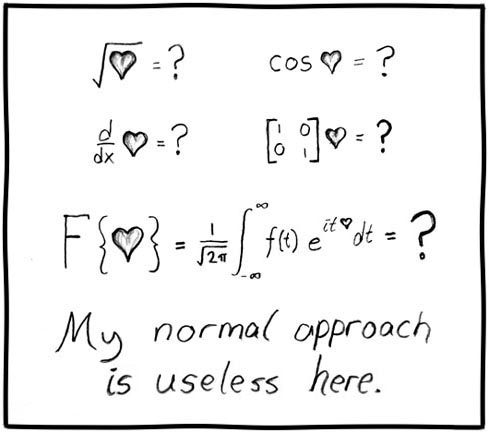
Useless

Someone special sent me this: / Alguém especial enviou-me isto:


In love's math, the unit(y) is infinity... / Na matemática do amor, a unidade é o infinito...

2007-10-12

Why publishing matters?

Some of you might ask: why so much trouble finding about conferences or journals? Can't I just do my job, get my degree and get on with life? Do I really need to write a paper about what I'm doing?

In my experience, publishing is more important than it seems at a first glance. Why? Mainly for two reasons:

1 - When you write down your ideas and work in paper form - with concise, well-written text, and full referencing - you are forced to summarize your ideas and to look at what other people are working on. It makes on focus on what you do better or differently. It makes you distill what you did.

2 - When you share your work with an interested audience, you get feedback from other people that can reason about what you're doing. This enables you to anticipate the criticisms your work will face, and do something about it before it's finished.

Conference posters are more suitable for on-going work, as they maximize the feedback from more diverse people. Conference paper presentations are usually attended by fewer, less diverse people, but the feedback is more focused.

Never forget to make your contacts visible! Sometimes the feedback comes after the conference.

You can also keep a publications page, so that people may easily find your work on the web. However, there must be a disclaimer.

2007-10-05

Sharing International Conferences with Google Calendar

Following my paper search, I identified international conferences on subjects relevant to my research. These are potential submission targets. Papers are excellent deliverables that can also work as a research milestones.

I use a public Google calendar to share this information with anyone who is interested. The address is the following: International Computer Science Conferences

If you want to cooperate in keeping this calendar up-to-date, please let me know.